It was late August as I blissfully floated on a raft in the middle of a small lake in northwest Davidson County, outside Nashville. It had been hot and dry for weeks and the spring-fed lake seemed the very best place I could be on that particular afternoon.
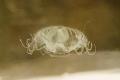
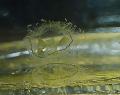
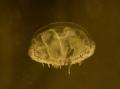
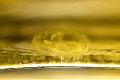
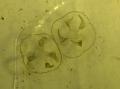
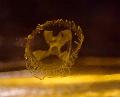
I was lying face down with my nose almost in the water when I began to see small, disc shaped creatures rising and falling in the green-tinted water. Each was about the size of a nickel and almost totally transparent except for a whitish X or cross in the center of its circular form. I cupped my hand under one of them and brought it closer. As the water trickled through my fingers the creature slid across my palm, producing no more sensation than a moonbeam. Once back in the water it pulsated rhythmically and slowly moved away from the raft. I was enchanted.
As soon as I could bear to leave my mesmerizing swim buddies, I went home to do an internet search. I used the words “freshwater jellyfish” as my search terms. Within moments I had confirmed their identity. They were indeed freshwater jellyfish, immature medusae, one stage in the life cycle of Craspedacusta sowerbii. Freshwater jellyfish differ slightly from true marine jellyfish in some of their physical structures. There are over 10,000 species of marine jellyfish but only one species of freshwater jellyfish. It belongs to the class known as Hydrozoa and fossil records of this jellyfish variety date back to the Pre-Cambrian era. They were first recorded for taxonomic purposes in England in 1880 but the U.S did not report the creature until 1908. They have been found in 43 of 50 states.
I had serendipitously met C. sowerbii in its typical habitat: a freshwater lake. It is also found in water-filled gravel pits, quarries, and other locations that feature calm water. It is easy to see why it would prefer calm waters; so small and delicate, it could be easily torn apart by any turbulence. It is also found in quieter portions of the Ohio and Tennessee Rivers and other waterways. It can be found in clear water or in soupy green farm ponds but water with a high concentration of chloride does not provide a favorable environment.
What I had observed was a medusa “bloom”. This phenomenon is very unpredictable and sporadic. It may not occur every year in the same location. It may appear suddenly in locations where it has never been seen before. It may be encountered one year and never seen again. I consider myself fortunate to have been at this location at the time the medusae chose to bloom. Blooms generally occur in August and September and are not usually reported in waters where the temperature is below 82 degrees Fahrenheit. Incidentally, jellyfish swimming in a group are called a “smack” of jellyfish.
Medusae do not “see” in the traditional sense but they do seem to be sensitive to light and dark. Since they don’t see their food, medusae actually locate their food by accident. During this stage of their existence they search for their food by gradually descending through upper, warmer layers of water until they encounter something they recognize as an acceptable food source. Most of the time it is a very small meal but they can ingest (and digest) larger food items as long as they can pull them through the tube that runs from their mouth to their stomach. Medusae in turn become meals for certain other water creatures such as crayfish.
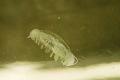
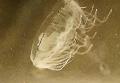
For much of its life, C. sowerbii lives in polyp form, usually in colonies. Polyps resemble tiny hollow bowling pins made of jelly. A polyp is attached by its stalk to almost any underwater structure including rocks, roots, and vegetation. The polyp colonies feed on zooplankton (microscopic animals that are suspended in the water) and reproduce asexually during the spring and summer months. In winter the polyp shrinks into a form called a podocyst. As a podocyst, it can stick to the legs of herons or other wading birds and be transported to other locations. When spring arrives, the podocysts resume their polyp form. When conditions are optimal, a medusa bud forms on the side of the polyp and a medusa grows from this bud, then separates from the polyp. What I saw were newly separated, immature medusae, the free-swimming form of C. sowerbii. A fully matured medusa is about the size of a quarter and has a domed structure like that of an umbrella. From the outside edges of the “umbrella” hang long tentacles with the capability of stinging small prey such as macro invertebrates or small fish. It is not thought that the stinging cells (nematocysts) on the tentacles of mature medusae can penetrate human skin. If you ever encounter a mature medusa, I’ll let you be the judge! The stinging cells are located at the very end of the tentacles and after stinging and paralyzing a small water creature, the tentacles are also used to convey the food to the mouth of the medusa. Going back to our umbrella model, imagine a medusa drawing a tiny fish to its mouth area located where the umbrella “handle” would normally be located. Mature medusae are capable of sexual reproduction but research shows that in the U.S. most C. sowerbii reproduction takes place asexually during the polyp stage. The reason that medusae, even when mature, rarely reproduce sexually, is that most blooms consist of all males or all females.
Assuming that a medusa does reproduce sexually, the life cycle of the freshwater jellyfish would proceed as follows:
- Fertilized eggs are produced by mature medusae.
- Fertile eggs become larvae (planula).
- Larvae sink to the bottom, affix to underwater objects and become polyps.
- A polyp can form one type of bud which produces another polyp, asexually. Eventually this produces a colony of polyps.
- A polyp is also capable of forming another type of bud that becomes a slug like form called a frustule. This form has mobility and can creep slowly across the bottom to another nearby area, then settle down as an ordinary polyp.
- Yet another type of polyp bud becomes the immature medusa that will make its way to the surface.
- The immature medusa eats and grows over the summer until it is a fully matured medusa capable of sexual reproduction.
The cycle continues!
If you would like to see photos and movies of C. sowerbii, or if you have personally seen a medusa bloom, I would recommend that you visit websites devoted to this topic. Not everything is known about this elusive creature and you will find some researchers on the web actively soliciting information from observers of blooms. If you should be so fortunate as to catch a glimpse of medusae in bloom, write down where and when it occurred and submit your information on one of these websites. Doctor Terry L. Peard, a professor and researcher at the Indiana University of
Pennsylvania in Indiana, Pennsylvania has an especially good internet site on this jellyfish and is very happy to receive detailed information and photos or videos. You, amateur biologist, can contribute to the C. sowerbii knowledge base!
|